
Fashion designer, Belinda Compah-kegeke said in her CNN interview, “When we are born, we are wrapped in a wax print. It is a major part of every Africa’s heritage and every wax print tells a unique African story.”




Fashion designer, Belinda Compah-kegeke said in her CNN interview, “When we are born, we are wrapped in a wax print. It is a major part of every Africa’s heritage and every wax print tells a unique African story.”
Fashion designer, Belinda Compah-kegeke said in her CNN interview, “When we are born, we are wrapped in a wax print. It is a major part of every Africa’s heritage and every wax print tells a unique African story.”
Ankara, a textile used to make African prints is also called African wax prints fabric, Holland wax, or Dutch wax.
This African print is known for the radiant colours of its fabrics.
One Amazing thing about Ankara fabrics is that the degree of its intensity does not allow it to fade away quickly like other fabrics.
This is because of the “wax resistant” technique applied in printing the textile.
Would you believe that this African textile-Ankara did not originate from Africa? In the year 1846, printed cotton was in high demand, so a Dutch entrepreneur, Pieter Fentener Van Vlissingen mechanised the method used to make prints on batik-which is a popular cloth worn in Indonesia.
Yes, you read that right, the African textiles that is widely known as ‘Kitenge’ in East Africa and ‘Ankara’ in West Africa were first produced in Indonesia by a Dutch entrepreneur. His company, Vlisco, introduced the printed textile to Ghana, and the fabric gained an African identity.
The fabric was not well received in Indonesia, and when Pieter noticed how Africans were requesting the fabric in high demand, he focused more on getting the prints to them.
What was once considered to be a local market has grown beyond the continent’s shores to meet the increasing demands of the fabric worldwide.
From the streets in Africa to runways all over the world, Ankara has proven to be so versatile that it is now on the global fashion scene.
Ankara fabric has moved from just a local attire to become a glamorous wardrobe must-have, putting Africa under the spotlight.
African designers and their African designs are now sought out in all corners of the global society. A lot of Ankara fashion shows come up every day all over the global fashion scene. One of the noteworthy fashion shows is the annual Ankara Festival hosted yearly in Los Angeles, California. The festival or AFLA as it is commonly called was birthed in 2010 to increase the visibility of African culture through fashion, music, dance, arts, and food. The festival showcases modern African Designs in African print (Ankara), established African and African-inspired designers, young up and coming designers by providing them a venue to showcase their abilities, and develop their ambition in the international fashion area.
The Ankara invasion was another noteworthy development which placed different items fashioned out of Ankara fabric; bags, shoes, jewellery, etc, in noticeable places where it was formerly viewed as improper or unsuitable.
Ankara used to be a fabric that had no glamour value or fashion importance. It was a regular fabric that would not warrant a second look. This was the perception until 2002 when Ovation magazine popularized the trend locally and every lifestyle magazine had a feature on Ankara and its versatility. But then it only appealed to an older audience and was only seen at weddings and other conformist celebrations.
The designs were not as varied or as exotic as it is today. The challenge for the mass consumption of this trend was to balance its fashionable aesthetic to a sort of exclusivity. According to the former National President of the Fashion Designers Association of Nigeria (FDAN), “fabrics sold to the Nigerian market are used mostly by the womenfolk to do wrapper and tops, and I think it is a little uncomplimentary if I make clothes for a guy and he adorns it to go to a party, only to see a woman selling groundnut (epa) along the road, tying it as a wrapper.
I have done it before, so I opt to use fabrics that are not common in the local market”. When the balance was found, globalization and intense media exposure ensured that local and international observers absorbed the trend. African fashion designers became more popular, and Ankara was more prominent in fashion; Vlisco, the African print manufacturing company, also gained ground in Nigeria. One of the key actors in the proliferation of African prints in the fashion industry was the fashion designers.
A few designers who began using African prints in their collections were, Uduak
Umondak, Olujimi King, and Abba Folawiyo all had their own designer labels/fashion houses.
Uduak Umondak’s label is called Colors and her designs are just as the name suggests and very vibrant and playful.
She started using Ankara in 1997 and had a fashion show to showcase her Ankara collection. Olujimi King kick-started the use of African prints for modern and Western designs. The most unique thing about him is that he usually makes his fabric. Abba Folawiyo owns the very prominent fashion house Labanella. She
started the trend of combining African print fabric with brocade.
These designers paved the way for a bigger phenomenon. These designers although historically significant to the transformation of Ankara were unable to bridge the generation gap and surpass the local market, which the newer generation of African designers have been able to do. They have been responsible for the transition of this trend from the local to the international fashion scene. They are designers like Lisa Folawiyo, Ituen Basi, Deola Sagoe, Christie Brown and Duro Olowu. Ituen Basi is what you would call innovative; her creativity is inspiring
and it works. She brought back the iro and buba trend and also glamorized African prints in jewelry and accessories. She plays with colors and mixes different prints of fabrics for an outfit. Ghanaian designer Christie Brown, just like Ituen, has reinvented African accessories and jewelry by using African prints; her necklaces in particular are spectacular. Deola Sagoe is not a new comer in the fashion industry; she has experience and has made quite a reputation for herself. She works with different kinds of fabrics including African prints, and her designs are contemporary.
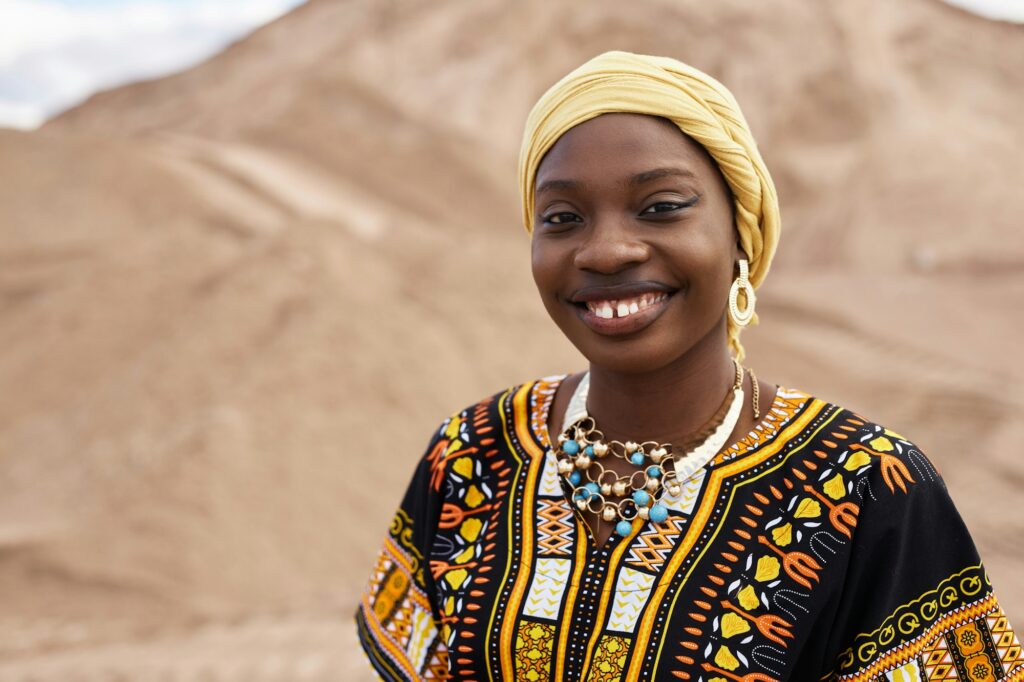
International celebrities like Lydia Hearst and Anika Noni-Rose have worn Deola’s designs on the red carpet.Duro Olowu mixes African prints impeccably; his most recent accomplishment is dressing the first lady of the United States of America, Michelle Obama.
A Nigerian fashion designer, Duro Olowu, said “For a long time, there was a sense that this was limited to Africa but now it has become global. Combined with an awareness of social responsibility, it makes for a powerful statement.”
Countless number of international designers have launched various designs revolving around the Ankara fabric. Designers like Marc Jacobs, Givenchy, Jean Paul Gaultier, Eley Kishimoto, Gwen Stefani, Paul Smith, Kenzo, Diane Von Furstenberg and Dries Van Noten among others have included items fashioned out of Ankara fabrics in their Designs.
Many renowned celebrities have also jumped on this Ankara fashion trend.
Celebrities like Beyoncé, Rihanna, Solange Knowles, Thandie Newton, Gabrielle Union, and Former first Lady of America Obama, to name a few have been spotted in daring Designs using one or more Ankara fabrics. The rise of the trend isn’t just for celebrities alone. A lot of foreigners have also joined the movement. The fabric is commonly referred to as “African prints” in their circles.
Many renowned celebrities have also jumped on this Ankara fashion trend.
Celebrities like Beyoncé, Rihanna, Solange Knowles, Thandie Newton, Gabrielle Union, and Former first Lady of America Obama, to name a few have been spotted in daring Designs using one or more Ankara fabrics. The rise of the trend isn’t just for celebrities alone. A lot of foreigners have also joined the movement. The fabric is commonly referred to as “African prints” in their circles.
ANKARA AND THE WORLD’S FASHION INDUSTRY
Fashion enthusiasts have taken a step further to make different designs with the Ankara print, infusing pop culture and European Designs.
Many years back, the best that could be achieved with the Ankara fabric was the traditional African wear-Iro and Buba. However, today, the African print Ankara is used to make a lot of fashion items which include blazers, blouses, swimsuits, trousers, and gowns, among others. It is also used to make earrings, slippers, sandals, bags, phone cases and other accessories. Ankara overwhelmingly invaded the fashion industry. What was formerly seen as a local fabric for the poor and people with low income, now has a place in the world’s fashion industry where everybody sees it as a beautiful fabric to be worn. Many African Designers and international designers have introduced Ankara into their fashion design collections.
The world’s fashion industry is exploring Ankara and has shown how Ankara can be versatile, beautiful and exceptional.
These Ankara Designs are so beautiful that they always find a way to make a statement. Ankara and the world’s fashion industry have found a way to find a balance ground and merge to create world class beauty.
Should we talk about the colours, patterns and how vibrant the Ankara print looks?
One thing is certain whilst wearing Ankara print, you’re bound to always stand out!
The Ankara fabric is unique and sells our unique culture. It is colourful and has a way to please the eyes. With its beautiful Designs that allow it to be made into anything wearable. The fabric is now globally accepted and is more than just a local wear, it is now a modern wear that has gained international acceptance.
Chioma Inyang
A picture surfaced on the internet of a bride, Chioma Inyang, who made a bold choice to use the Ankara fabric to sew her wedding dress. The dress sparked a lot of conversation in social media while some people argued that the woman chose the fabric out of lack of money to get a better wedding gown, others praised her choice and commented on how beautiful the fabric was.
In an interview she had with BBC, Chioma Inyang said “Lack of money wasn’t the reason I chose to sew my wedding dress with Ankara. The problem we have now is that we haven’t acknowledged our African roots. As a child, I told myself that on my wedding day I would wear a traditional African dress.
Fortune Louis Hogan, a Nigerian who trades in Ankara, spoke very highly of the fabric saying it can be styled to suit any occasion.
“Unlike other materials, with Ankara, you can decide to sew a traditional or English style; and both outfits will come out nice and unique.
The beauty of the high-quality Ankara is how durable they are. It is possible to use them for many years and they will not fade. Even when you wash them over and over again, the fabric remains intact,” she said.
Also, a woman who simply identified herself as Deborah said household items produced from Ankara are as durable as products from other materials.
Products made from Ankara are as durable as any other material. However, the durability depends on the quality of the fabric used.
That is why we ensure that all African prints we use for production are water-tested to ensure quality,” she said. One of the interesting things about Ankara is how each design and pattern is unique, especially when compared to how pale and bland other fabrics can be.
No two materials explore the same design. And they come in different colours and shades.
In Nigeria, Ankara is regarded as a very special material, so it is not worn all the time. Most people tend to wear it on days they believe to be special or during events, such as the aso-ebi used for weddings and other occasions
Aside from attires for both males and females, a few entrepreneurs have decided to branch out of the norm and explore what other beautiful products can be made from the material, including bedsheets, tablecloths, ties, table mats, baby carriers etc.
Deborah Akingboye, an Abuja-based entrepreneur who creates home essentials using Ankara said, “I have been in this business for two years, and I must say that people are beginning to appreciate the use of Ankara for other things, apart from clothes.” Because Ankara is embraced widely by many Nigerians, it is sold in every market. Deborah explained that since the fabric is popular, she sourced it from different parts of the country.
She also said the prices depended on quality. Deborah’s brand uses Ankara to make
beddings, duvet, throw-pillows, table runners, chair covers, drawstrings andcurtains.
“Our prices range from N1,500 to N25,000. Our 14-inch throw-pillows range from N1,500 while our king-size duvet with bed-sheets costs N25,000.
“The prices are not fixed because sometimes, customer’s specification will change the prices of goods. In most cases, we always try to work with customers’ budgets,” she said
Deborah is glad that her business receives enough patronage. “We get orders for different products frequently.
Most times, the season also contributes to the type of item that would be requested for. For example, there will be more orders for bed sheets and duvets during the rainy season.
“Our Instagram highlights a list of different products from our brands, and we take pride in the fact that they are the truth. We are bold to say that so far so good, our reviews have been encouraging.
“We also acknowledge that we have received negative reviews. In such cases,
we always work on correcting those issues immediately they arrive.
“In the past, people didn’t understand it, so they found it weird, but in recent times, Ankara designs have slowly eased into our way of life and people are beginning to applaud and appreciate the creativity that comes with it.
“Each time we introduce a new product, the responses we get from customers are encouraging. This shows that people are slowly but surely appreciating Ankara crafts and designs,” she said.
Ankara invaded the global fashion industry and made a lasting impression.
The African print is truly here to stay, blessing us with its vibrant colors, patterns and Designs.

There is a new trend on social media these days. And while this trend often makes me proud, it also makes me sad at the same time. I’m talking about young black people from West Africa leading their classes and being valedictorians in Harvard, Yale, Sheffield and other Universities and schools in the UK, US, …
From Underfunded national leagues and abysmal performances on the international stage to Gross Mismanagement of Funds by Troubled Associations, Africa’s Football Associations have not had it easy over the years. In Present Day, Sports, – and Football in particular, have intimately become interwoven with the developmental issues of the continent.
Ipolowo oja l’agunmu owo is a Yoruba adage that translates to; promotion is the magic potion for business, and this is true for the sports business. Sporting events are organized throughout the year in Nigeria and West Africa, yet, these events are held with little or no relevance; stadiums are nearly empty, there is insufficient …

Extraordinary! That’s the word that best describes the performance of certain African countries in the 2022 Commonwealth Games and like we would always say, a win for one is a win for all. The 22nd edition of the Commonwealth Games officially known as XXII Commonwealth Games and commonly called ‘Birmingham 2022’ after the host city- …

